The haul truck you’re relying on today was probably sending you warning signals three weeks ago. Not through an alarm. Through its data – coolant temperature trending two degrees above baseline, oil pressure holding just below normal, a vibration pattern shifting across the gearbox that no scheduled inspection would have caught.
If no one was reading those signals systematically, you’ll find out about the fault the hard way: mid-shift on the haul road, with an expensive breakdown, a stopped machine, and a maintenance crew scrambling on emergency time.
Predictive maintenance for mining equipment is the discipline of catching those signals before they become stoppages. Not on a schedule. Not after the fact. When the data actually shows a problem developing – and before it turns into a breakdown that halts production.
This guide covers how predictive maintenance works in a real mining environment, how to build a program that reduces downtime, what your OEM data is already telling you, and the one step most programs skip that determines whether the whole thing holds together.
Key Insights
- Unplanned downtime on a large mining haul truck carries a steep cost in lost haulage capacity and production impact – and emergency repairs cost significantly more than the same work done during a planned maintenance window.
- Most mining operations are sitting on a goldmine of OEM machine data (CAT VIMS, Komatsu KOMTRAX, Liebherr LiDAS) that they’re either not reading systematically, or acting on too late.
- Predictive maintenance programs that only raise alerts without root cause analysis create alert fatigue, not reliability. Your team needs to know what is failing, why, and where.
- The most overlooked gap in mining maintenance is verification: knowing that a repair actually resolved the fault, not just that a work order was closed. This is where most programs quietly fail.
- Getting started doesn’t require replacing your existing systems. The right platform connects to your existing OEM data and adds targeted instrumentation where needed.
- McKinsey research shows predictive maintenance reduces unplanned downtime by 30-50% and maintenance costs by 18-25% versus time-based preventive programs.
- A predictive maintenance program is only as good as its last verified repair. Confirming the fault signature has resolved post-repair is what separates programs that work from programs that create paperwork.
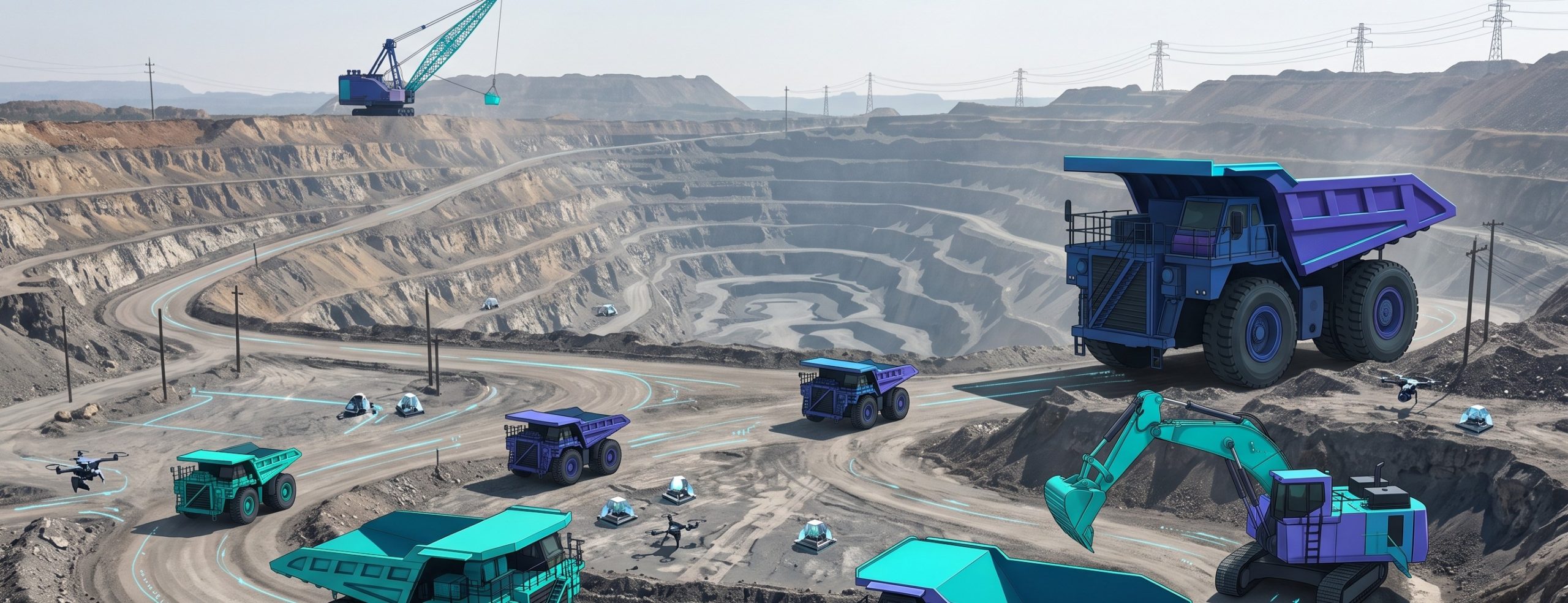
What Is Predictive Maintenance in Mining – And Why the Old Way Is Costing You
Reactive, preventive, and predictive: the three approaches compared
Most mine sites run a mix of all three maintenance approaches. Understanding where the money leaks helps you see why predictive maintenance pays for itself fastest.
Reactive maintenance (run to failure) is the most expensive approach in mining, even though it looks cheapest on paper. You pay emergency rates for parts, overtime for crews, and lose production while the machine sits. Emergency repairs typically cost significantly more than the same work carried out on a planned schedule.
Preventive maintenance (time-based or hours-based) is better, but it has a structural problem: components don’t degrade on a calendar. Replace a gearbox at 10,000 hours and you’ve either pulled it too early – wasting usable life – or missed the actual failure that happened at 9,200 hours under abnormal load conditions. The schedule is a proxy for condition. It’s always slightly wrong.
Predictive maintenance (condition-based) acts on what the data actually shows. Components are serviced when sensor readings, OEM telemetry, and oil analysis patterns indicate wear – not when a planner’s calendar says so. The result: maximum component life, planned maintenance windows instead of emergency stops, and a maintenance team that’s ahead of the machine rather than behind it.
| Approach | Cost Profile | Downtime Type | Equipment Life |
|---|---|---|---|
| Reactive | Highest – 3 to 9x emergency premium | 100% unplanned | Shortest |
| Preventive | Moderate – planned parts, some emergency | Mix of planned + unplanned | Moderate |
| Predictive | Lowest over time – condition-driven | Predominantly planned | Longest |
The real cost of unplanned downtime on a haul truck – numbers, not estimates
Unplanned downtime on a large mining haul truck is expensive in lost haulage capacity, idle crew costs, and production impact. On a high-production open-pit site, the bottleneck effect through the haulage cycle can compound that impact significantly across the entire operation.
Emergency repairs performed under pressure cost substantially more than the same work carried out in a planned maintenance window. The labour, parts logistics, and lost production premium on an unplanned breakdown is where the real cost accumulates – not just the repair itself.
McKinsey research also puts maintenance expenditure at up to 50% of total operational cost in asset-intensive industries – making maintenance strategy one of the highest-leverage decisions available to a mine site.
Why time-based PM still causes failures
Scheduled maintenance intervals are built on average failure rates across a fleet and an average operating environment. Your haul roads aren’t average. Your payload distribution isn’t average. Neither is your altitude, your dust loading, or the variability across your operator pool.
A haul truck running 20% over target payload on a steep grade wears its drivetrain at a fundamentally different rate than the same model on a flat, lightly loaded run. Scheduled intervals can’t account for this. Condition-based monitoring can.
What Your Mining Equipment Is Already Telling You
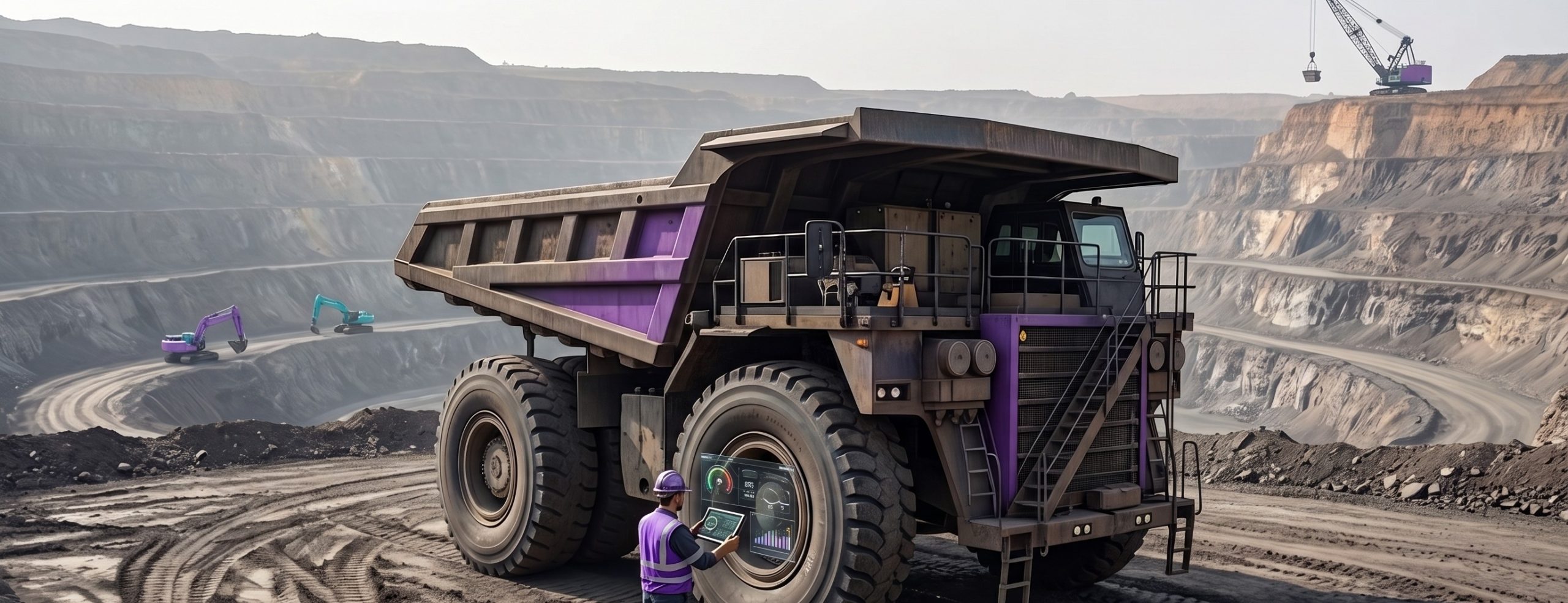
OEM machine data 101: what CAT VIMS, Komatsu KOMTRAX, and Liebherr LiDAS generate
Post-2015 mining equipment runs with sophisticated onboard monitoring systems. A CAT 793 haul truck generates hundreds of CAN bus data points continuously through VIMS (Vital Information Management System). Komatsu’s KOMTRAX does the same. Liebherr’s LiDAS records critical component parameters across the driveline, hydraulics, and electrical systems.
These systems broadcast continuously: engine load, coolant temperature, transmission oil temperature, hydraulic pressures, brake temperatures, payload, cycle data, fault codes, and more – shift by shift, asset by asset.
Most mining operations see this data in OEM dashboards or receive periodic reports. Very few are running it through an intelligence layer that connects the dots between signals, identifies developing patterns, and surfaces meaningful warnings from the noise. For a closer look at 7 high-impact haul truck failure modes and the signals that appear first, see our companion guide.
The data signals that matter most for mobile fleet
For haul trucks and loaders, the highest-value predictive signals are:
- Transmission and gearbox oil temperature and pressure – deviations from baseline often precede gear train failures by 2-4 weeks
- Engine oil pressure and coolant temperature trending – gradual shifts indicate developing bearing or coolant system faults before they become audible
- Vibration patterns – component-level vibration changes indicate wear well before it registers in performance metrics
- Oil analysis and particle count – metal particle counts in oil samples are among the most reliable early indicators of internal component wear
- Duty cycle and payload data – abnormal loading patterns accelerate wear in ways that shift the timing on every other signal
No single signal tells the complete story. The value is in reading them together – when transmission temperature, oil pressure, and vibration all trend in the same direction on the same component, that agreement is what separates a genuine developing fault from sensor noise.
Why raw data without intelligence creates alert fatigue instead of reliability
Most OEM monitoring systems alert on threshold breaches – when a value crosses a line, a flag appears. This approach has a problem: in a real mining environment, parameters cross thresholds constantly for normal operational reasons. A truck climbing a steep grade runs hot. A loader in peak ambient temperature triggers temperature alerts. These aren’t faults – they’re operating conditions.
When every alert looks the same, real warnings get buried in the noise. Maintenance teams learn to filter, and when they filter, they sometimes filter the one alert that matters.
Effective predictive maintenance requires an intelligence layer that understands what’s normal for your specific machine, your specific environment, and your specific fleet history – so that when a genuine developing fault appears, it surfaces clearly with context: what is failing, why, and where.
DataMind AI: Razor Labs’ DataMind AI connects to your existing OEM data streams – CAT VIMS, Komatsu KOMTRAX, Liebherr LiDAS, and others – and builds the intelligence layer on top. Where OEM data doesn’t provide sufficient coverage on specific components or failure modes, Razor Labs installs supplementary sensors and hardware to fill those gaps. The starting point is always what your equipment already generates. The platform adds targeted instrumentation where needed to complete the picture.
How to Build a Predictive Maintenance Program for Your Fleet
Step 1 – Identify your highest-risk assets
Not all equipment generates equal maintenance risk. Start with the assets where unplanned failure has the greatest impact on production and cost.
For most open-pit operations, haul trucks are the clear starting point – specifically the gearbox and differential, which consistently represent the highest-value failure prediction opportunity. A failed haul truck gearbox doesn’t just stop one machine. It creates a bottleneck through the entire haulage cycle and can trigger emergency repair logistics that dominate your maintenance budget for weeks.
Rank your assets by: failure cost per event x failure frequency x production impact. The top three or four on that list are where a predictive maintenance program pays off fastest.
Step 2 – Connect to your existing data AND augment where needed
The good news for operations running post-2015 equipment is that the foundational data already exists. OEM telematics systems are broadcasting continuously. The first step is connecting your predictive maintenance platform to those existing streams – not replacing them, not ignoring them, building on them.
From there, a thorough equipment assessment identifies the gaps: components that the OEM system doesn’t cover at sufficient resolution, failure modes that require additional vibration sensors, or monitoring points that have never been instrumented. These gaps are filled with targeted sensor and hardware installation, added on top of your existing infrastructure.
The goal is a complete monitoring picture – starting with what you have, adding what you need.
Step 3 – Establish baselines and failure thresholds
Once data is flowing, the first phase is learning. Baseline periods – typically 6-12 weeks of clean operating data – establish what ‘normal’ looks like for each asset in your specific environment. Normal for a CAT 793 on a 15% grade at altitude is different from normal for the same model on a flat coastal run.
These baselines become the reference point against which every future reading is compared. Deviation from baseline – not deviation from a generic OEM threshold – is what triggers meaningful, actionable alerts.
Step 4 – Build your maintenance response workflow
A predictive system is only as good as the workflow connected to it. When a developing fault is flagged, who receives it? What’s the decision tree? How does it move from alert to work order to scheduled maintenance window?
The workflow design matters as much as the technology. Predictions that sit in a dashboard nobody checks don’t prevent breakdowns. Build a clear escalation path: fault detected – ranked by severity – assigned to maintenance planner – work order raised – scheduled in next available planned maintenance window.
Step 5 – Close the loop: verify the fix, not just the work order
This is the step most programs skip – and where the most money quietly leaks.
A maintenance technician replaces a gearbox seal. The work order gets closed. The fault record is updated. Two weeks later, the same temperature signature reappears on the same machine. The seal replacement addressed a symptom, not the underlying fault.
In a traditional program, you find this out at the next failure. In a closed-loop predictive maintenance system, you find out immediately – because the platform continues monitoring the fault signature post-repair and flags it if the pattern persists.
DataMind AI: DataMind AI closes this loop directly. After a maintenance action is logged, DataMind AI monitors whether the fault signature – the actual data pattern that triggered the alert – has resolved. If it hasn’t, the system flags it again. Not ‘the technician replaced the part and closed the ticket.’ But ‘the temperature and pressure pattern that indicated the fault has normalised – repair confirmed.’ That’s a fundamentally different standard of verification, and it’s the one that actually protects your uptime.
Predictive Maintenance for Mobile Fleet: What to Monitor and When
Haul trucks – the highest-value monitoring target
For CAT 793, Komatsu 930E, Liebherr T 284, and similar large haul trucks, the failure modes worth monitoring first are:
- Gearbox and differential: transmission oil temperature, pressure trending, and vibration patterns – deviations from baseline 2-4 weeks before failure are consistently detectable across multiple signal types
- Engine: oil pressure, coolant temperature trending, blow-by gases, and injection timing deviations
- Hydraulic system: pressure differential across filters, cylinder seal integrity, and pump efficiency trends
- Brakes: retarder temperature under load, pad wear indicators, and brake apply pressure consistency
- Tyres and payload: overloading events and tyre pressure monitoring – under-inflation accelerates structural fatigue and affects every other drivetrain signal
A 20-truck haul fleet monitored to this level gives your maintenance team a clear, ranked view of every asset’s health – not a stack of raw OEM alerts, but a prioritised list of developing faults with root cause and recommended action.
Loaders and dozers – the undermonitored fleet
Loaders and dozers are frequently under-monitored relative to haul trucks, despite contributing significantly to production loss when they fail unexpectedly. Key monitoring priorities:
- Hydraulic system: bucket and lift cylinder pressure, pump efficiency, filter differential pressure
- Drive train and final drives: oil temperature and pressure in the final drive housings – often the first indicator of internal wear
- Cutting edges and ground-engaging tools: cycle-count tracking combined with load monitoring can indicate replacement timing before performance loss becomes visible
Drill rigs and rotary equipment
Drill rig failure during blast preparation can delay an entire production blast and throw the mine schedule back by days. High-priority monitoring points:
- Rotation head: motor load and temperature under varying formation resistance – abnormal load signatures indicate tooling wear or ground condition changes
- Feed system: hydraulic pressure and travel speed consistency – deviations indicate cylinder or pump wear
- Dust collection system: differential pressure across filters – blocked dust collectors cause premature air system and engine wear that shows up as a secondary failure
- Compressor system: discharge pressure and temperature trending – early indicators of valve or ring wear
The 5 Reasons Predictive Maintenance Programs Fail in Mining
1. Alert overload without root cause
The fastest way to kill a predictive maintenance program is to flood the maintenance team with alerts they can’t act on. If every alert says ‘temperature elevated’ without telling the team which component is at risk, why it’s elevated, and what the likely failure consequence is, the alerts become noise – and noise gets ignored.
Effective predictive maintenance doesn’t raise alerts. It raises diagnoses. The difference between ‘coolant temperature threshold exceeded on Unit 14’ and ‘Unit 14 – developing thermostat fault based on coolant temperature trending above baseline under normal load for 11 days – recommend inspection within 72 hours’ is the difference between a dashboard your team checks and one they mute.
2. No verification layer – repairs that don’t actually fix the fault
In most operations, the maintenance data trail ends when the work order closes. The fault record is updated, the machine returns to duty, and the predictive system moves on. What actually happened to the underlying fault signature? Nobody checks. The next data point is the next failure.
Build a verification layer into your program – whether through manual follow-up protocols or platform-level closed-loop monitoring. The repair isn’t complete when the work order closes. It’s complete when the fault signature resolves.
3. Trying to cover everything at once
Starting a predictive maintenance program across an entire fleet at multiple sites simultaneously is one of the most common reasons programs stall. The data volume is overwhelming, the workflow change is too large, and the ROI case gets lost in the complexity.
The smarter approach is to start with a defined portion of your fleet – your highest-risk haul trucks at your most critical site – and establish proof of concept before expanding. For mining companies running multiple sites, a single-site pilot gives you a controlled environment to set baselines, refine the maintenance workflow, and build internal confidence before rolling out across the portfolio.
Once the results are clear – reduced unplanned stoppages, verified repairs, maintenance team bought in – expansion to additional sites or the full fleet follows naturally and with significantly less operational resistance.
4. Disconnected from the maintenance workflow
Predictions sitting in a separate platform that nobody integrates into daily operations are predictions that never prevent breakdowns. The predictive maintenance system needs to connect directly to your CMMS – SAP PM, Maximo, or equivalent – so that a flagged fault automatically generates a work order in the system your maintenance team already uses.
If acting on a prediction requires logging into a separate platform, copying data manually, and raising a work order by hand, it won’t happen consistently. Integration with your existing workflow is not optional. It’s what converts a predictive insight into a prevented breakdown.
5. No feedback loop – the system never gets smarter
A predictive maintenance model is only as good as the data it learns from. Every confirmed failure, every maintenance action, every repair outcome feeds back into the model and improves its precision over time. A system with no feedback loop delivers generic predictions based on generic failure patterns – forever.
Build the feedback loop explicitly: every maintenance action should be logged in the same system as the prediction, with outcome data – what was found, what was repaired, did the fault resolve? This data makes the model smarter, reduces false positives, and increases detection accuracy on your specific fleet in your specific environment.
What to Look for in a Predictive Maintenance Solution for Mining
Not all platforms are built for mining. Here’s what separates a solution that delivers in a real mine site environment from one that works in a pilot and struggles at scale.
OEM data compatibility AND sensor flexibility
The right solution connects to the OEM data your equipment already generates – CAT VIMS, Komatsu KOMTRAX, Liebherr LiDAS, and others. It doesn’t require you to replace existing systems or ignore the data infrastructure you’ve already built. It works with what you have.
But OEM data alone doesn’t always give you the full picture. The right solution should also have the capability to install supplementary sensors and hardware where OEM telemetry leaves gaps – adding vibration monitoring on a component that OEM telematics doesn’t cover at sufficient resolution, for example. Flexibility in both directions is what gives you complete asset visibility.
Root cause analysis – alerts vs. actionable diagnosis
Ask any vendor a direct question: does your platform tell me what is failing and why, or does it tell me a threshold was exceeded? The answer defines whether you’re buying a monitoring dashboard or a maintenance intelligence system.
Root cause capability requires the platform to reason across multiple signals simultaneously – cross-referencing temperature, pressure, vibration, and oil analysis data to identify the specific failure mode, not just the symptom. Without this, alert fatigue sets in within the first few months and the program quietly loses traction.
Closed-loop fault verification
This capability is rare. Most platforms monitor conditions and raise alerts. Very few continue monitoring after a repair to confirm the fault has actually resolved.
Ask the vendor directly: after we close a work order on a flagged fault, does your system continue monitoring the specific fault signature and confirm resolution? If the answer is no – or a vague ‘yes through our dashboard’ – that’s a program waiting to fail silently.
Tier 1 mining site experience
A platform that’s been deployed at research sites or small quarry operations is a fundamentally different product from one running at Tier 1 operations across APAC, Africa, and North America. Mining environments are harsh, data volumes are high, and operations don’t have time for solutions that work in theory.
Ask for references from operations of comparable scale and geography. The performance of a predictive maintenance platform at a Tier 1 site – where equipment mix is complex, the cost of a missed fault is large, and the maintenance team has zero patience for false positives – is the real validation.
DataMind AI: Razor Labs’ DataMind AI platform was built specifically for this environment. Deployed at Tier 1 mining sites across APAC, Africa, and North America, it connects to existing OEM data systems, adds targeted instrumentation where needed, delivers root cause analysis on every detected fault, and closes the loop to verify each repair actually resolved the underlying issue. To see it running on a fleet like yours, book a demo with the Razor Labs team.
Frequently Asked Questions
What is predictive maintenance in mining?
Predictive maintenance in mining is a condition-based approach that uses real-time data – OEM machine telemetry, vibration analysis, oil analysis, and temperature monitoring – to detect developing equipment faults before they cause unplanned failure. Instead of fixing equipment after it breaks or servicing it on a fixed schedule, predictive maintenance acts when the data shows a fault developing. For mining operations where unplanned downtime on a single haul truck is costly and can halt an entire haulage cycle, the goal is to catch warning signs that typically appear days or weeks before failure and schedule the fix during a planned maintenance window.
How is predictive maintenance different from preventive maintenance?
Preventive maintenance services equipment at fixed time or hour intervals regardless of actual condition. Predictive maintenance services equipment when condition data indicates it’s needed. Preventive maintenance either replaces components too early – wasting service life – or misses failures that develop between scheduled intervals. Predictive maintenance eliminates both problems by acting on what the data actually shows, extending component life while reducing both unplanned failures and unnecessary early replacements.
How much does unplanned downtime on a haul truck actually cost?
The exact figure varies by site, fleet composition, and production schedule, but the cost is rarely just the repair bill. On a high-production site, the bottleneck effect through the haulage chain can multiply the impact of a single truck going down across the entire operation, and emergency repairs performed under pressure cost substantially more than the same work carried out in a planned maintenance window – in labour, parts logistics, and lost production combined.
Do I need to install new sensors to start predictive maintenance?
Not necessarily as your starting point. Post-2015 mining equipment running OEM telematics – CAT VIMS, Komatsu KOMTRAX, Liebherr LiDAS – already generates hundreds of data points per machine per shift. A good predictive maintenance platform starts by connecting to that existing data infrastructure. Where OEM data doesn’t provide sufficient coverage on specific components or failure modes, supplementary sensors and hardware are added in a targeted way – filling the gaps without a wholesale hardware replacement across the fleet.
How long does it take to see results from a predictive maintenance program?
Most operations begin receiving meaningful predictions within the first 6-12 weeks – the time required to establish baseline health patterns for each asset in your specific environment. By the end of the first quarter, a well-implemented program has typically identified at least one developing fault that would otherwise have become an unplanned breakdown. Full ROI – typically measured as 30-50% reduction in unplanned downtime – is usually visible within the first 6-12 months of consistent operation.
What does the research say about predictive maintenance ROI?
McKinsey research consistently documents that predictive maintenance reduces machine downtime by 30-50% and lowers maintenance costs by 18-25% versus time-based preventive programs (McKinsey & Company, 2023: source). Deloitte’s Smart Factory research puts the downtime reduction figure at up to 50% and maintenance cost savings at up to 40% (Deloitte Insights: source). For a 20-truck haul fleet, reductions at that scale translate to a meaningful swing in annual maintenance spend and avoided production loss.
How do I know if a repair actually fixed the fault – not just closed the work order?
In a traditional maintenance program, you usually don’t – not until the machine either runs cleanly or fails again. Closing a work order confirms that a technician completed a task. It doesn’t confirm that the underlying fault condition has resolved. The right approach is to continue monitoring the specific fault signature after the maintenance action is completed. If the data pattern normalises, the repair worked. If it persists or reappears, something was missed. This closed-loop verification is what separates programs that actually reduce failures from programs that create well-maintained records.
What OEM data systems are compatible with AI predictive maintenance platforms?
The major OEM telematics systems – CAT VIMS, Komatsu KOMTRAX, Liebherr LiDAS, Hitachi ConSite, and others – all generate continuous machine data that can be connected to an AI predictive maintenance layer. The key question to ask any vendor is whether their platform has pre-built integrations with your specific OEM systems, or whether integration requires custom development each time. Platforms with established Tier 1 mining site deployments will typically have these integrations ready.
Can predictive maintenance work on older equipment without OEM telematics?
Yes, though the approach is different. For pre-2015 equipment without integrated telematics, the monitoring relies more heavily on externally installed sensors – vibration monitors, temperature sensors, and oil analysis – combined with structured inspection data. This is a valid starting point. The recommendation for mixed fleets is to start predictive monitoring on newer, telematics-equipped assets first, build program capability and team confidence, then extend to older equipment with supplementary instrumentation as the program matures.
What is the difference between condition monitoring and predictive maintenance?
Condition monitoring is the practice of collecting and observing equipment health data – vibration readings, temperature logs, oil analysis results. Predictive maintenance is what you do with that data: using it to forecast when a fault will develop into a failure and taking action before it does. Condition monitoring without the analytical layer that converts data into predictions and prioritised recommendations still leaves maintenance teams reacting to threshold breaches rather than anticipating failures. Predictive maintenance requires the intelligence layer on top of the monitoring data – and a workflow that connects that intelligence to a maintenance action.
See DataMind AI in Action at Your Site
Your fleet is already generating the data. DataMind AI connects to it, adds targeted instrumentation where needed, and closes the loop to confirm every repair actually worked. Site assessments take under an hour.