
April 15, 2026
Engine oil filtration system failures in mining haul trucks can lead to accelerated internal engine wear from contaminated oil circulation, potentially resulting in catastrophic bearing or piston damage. Detecting the difference between a genuine filtration restriction and a sensor anomaly requires correlating multiple pressure signals and maintenance context. DataMind AI continuously monitors oil differential pressure trends, main oil pressure, oil analysis results, and maintenance records in critical lubrication systems, enabling early detection of filtration degradation before it compromises engine integrity.
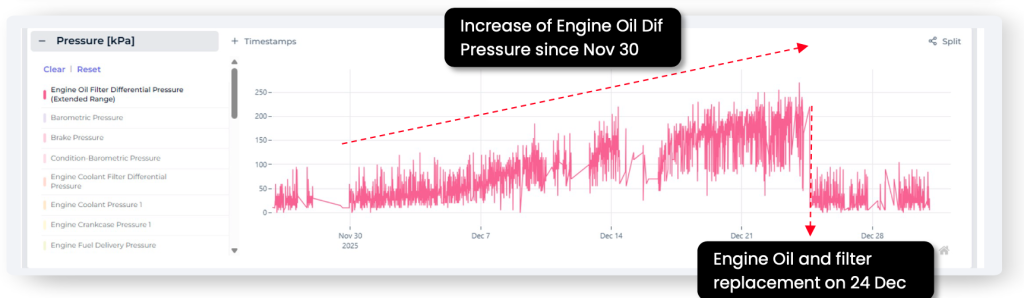
In this case, DataMind AI identified an abnormal upward trend in engine oil differential pressure on a Komatsu 930E haul truck, increasing from normal levels to 125 kPa between November 30 and December 9, then remaining fixed at that value. The main oil pressure stayed stable at approximately 450 kPa, while oil analysis results appeared normal. Notably, no eliminator fault or filter clogging event was registered by the OEM system. A cross-truck comparison revealed that this unit showed significantly higher differential pressure values than other trucks in the fleet, further confirming the anomaly.
By analyzing the divergence between rising differential pressure and stable main oil pressure, combined with the extended-range signal tracking above 200 kPa, DataMind AI identified a compound issue: the truck had been operating without a properly functioning eliminator (centrifugal filter), and the existing eliminator motor was found damaged. The fixed differential pressure reading also suggested a possible sensor or electrical component contributing to the abnormal signal behavior.
Based on DataMind AI’s early warning, the site team performed an engine oil and filter change on December 24, after which differential pressure dropped to 98 kPa. A new eliminator was installed, the damaged eliminator motor was replaced, and the maintenance frequency was adjusted to 500 hours for trucks without an eliminator. These targeted actions prevented potential engine bearing damage from inadequate oil filtration, avoiding an estimated 2 days of unplanned downtime and saving approximately $100,000.
Results at a Glance
$100,000
saved2 Days of unplanned downtime prevented
Conclusion
Abnormal oil differential pressure with fixed readings
Damaged eliminator motor and missing centrifugal filter
Prevented engine wear from inadequate oil filtration
Don’t let the next failure go undetected.
Explore 50+ real-world case studies showing how DataMind AI saves mining operations millions — or book a live demo to see it in action.
Fill in the form to download the case study
Don’t let the next failure go undetected.
Explore 50+ real-world case studies showing how DataMind AI saves mining operations millions — or book a live demo to see it in action.