Engine Bearing Wear from Soot-Driven Degradation Detected by DataMind AI in Komatsu 930E
September 29, 2026
Engine bearing failures in large mining haul trucks can lead to catastrophic connecting rod or crankshaft damage, resulting in complete engine replacement. Detecting the early stages of bearing wear requires correlating multiple data sources that individually may not trigger alarms. DataMind AI continuously monitors oil analysis wear metals, soot levels, exhaust gas temperatures, and turbocharger performance in critical engine systems, enabling early detection of compound degradation before it escalates into catastrophic failure.
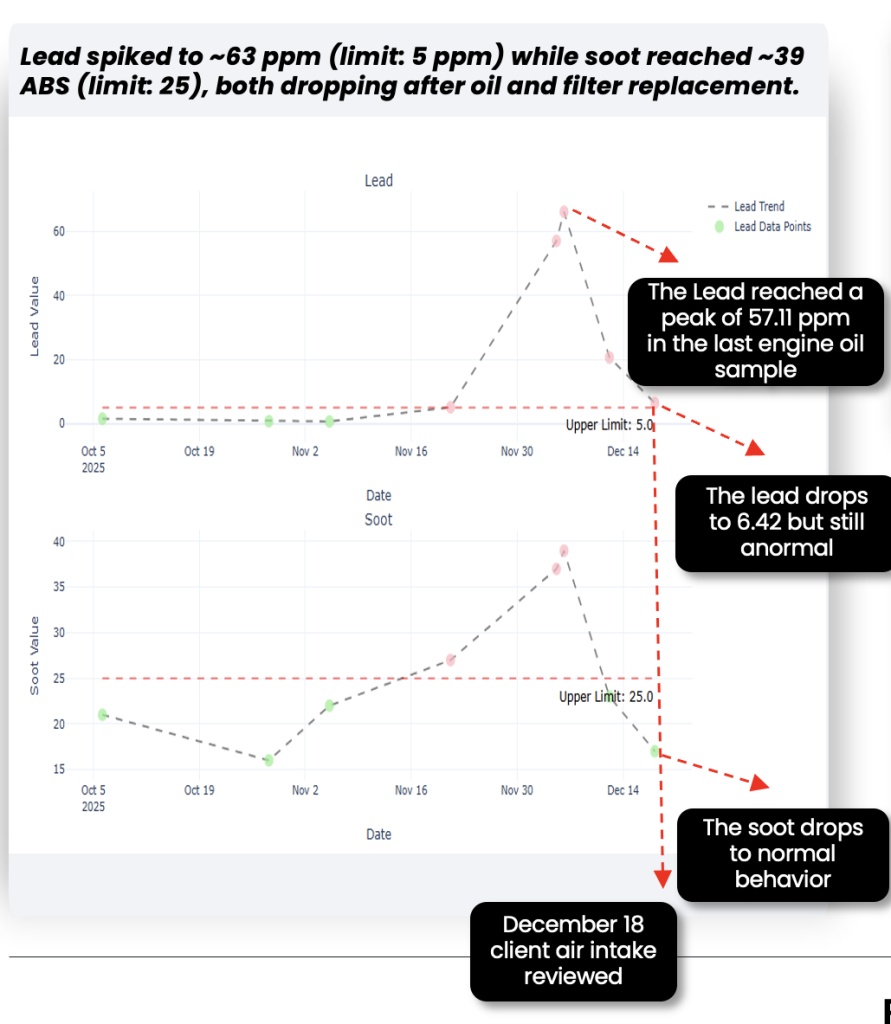
In this case, DataMind AI detected a critical lead peak of 57.11 ppm in oil analysis on December 5 for a Komatsu 930E haul truck, far exceeding normal baseline levels. Simultaneously, soot levels had risen to 37 ABS. Despite these alarming oil indicators, exhaust gas temperatures remained within expected ranges at approximately 500 degrees C, turbocharger boost pressure was stable at 243 kPa, and air filter differential pressure was only slightly elevated at 2.6 kPa, suggesting normal air-handling performance. This combination ruled out air intake or exhaust system faults as the primary cause.
By cross-referencing the lead-soot correlation with stable exhaust and turbo parameters, DataMind AI diagnosed progressive mechanical wear originating from rocker arm bushings or connecting rod bearings, both manufactured from lead alloy. The elevated soot contributed to accelerated bearing surface degradation through oil film contamination. A follow-up oil sample on December 18 confirmed improvement with lead dropping to 6.42 ppm after oil and filter replacement on December 12, supporting the soot-driven wear hypothesis.
Based on this early warning, the site team replaced engine oil and filters on December 12 and evaluated the intake system on December 18. These targeted actions arrested the bearing wear progression before it could advance to a catastrophic connecting rod failure, preventing an estimated 7 days of unplanned downtime and saving approximately $200,000 in potential engine rebuild costs.
Results at a Glance
$200,000
saved7 Days of unplanned downtime prevented
Conclusion
Critical lead spike with elevated soot in oil analysis
Soot-driven bearing surface wear in engine internals
Prevented catastrophic connecting rod or crankshaft failure
Don’t let the next failure go undetected.
Explore 50+ real-world case studies showing how DataMind AI saves mining operations millions — or book a live demo to see it in action.
Fill in the form to download the case study
Don’t let the next failure go undetected.
Explore 50+ real-world case studies showing how DataMind AI saves mining operations millions — or book a live demo to see it in action.