DataMind AI Detects Structural Looseness and Compressor Frame Crack Before Major Failure
August 20, 2026
Overview
DataMind AI™ was deployed at a large coal mining operation to continuously monitor a critical compressor in real time.
Over a six-month period, DataMind AI™ tracked an abnormal vibration pattern indicating a developing structural issue. Rather than simply flagging high vibration, the system analyzed how the compressor’s vibration behavior changed under different operating conditions. This deeper analysis revealed a pattern consistent with structural looseness, directing the site toward the machine structure and foundation as the likely source of the problem.
As the condition progressed, DataMind AI™ identified a significant increase in severity, prompting the site to carry out a targeted inspection. During the same period, the site’s routine vibration inspections, based on overall vibration levels, continued to classify the compressor as healthy.
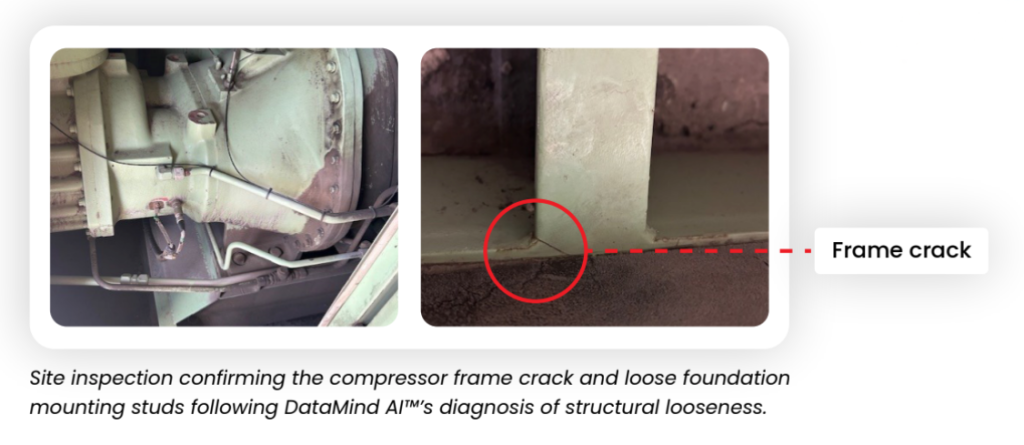
The inspection confirmed the diagnosis: loose foundation mounting studs and a visible crack in the compressor frame.
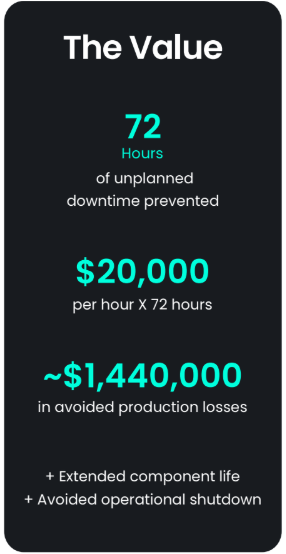
The early detection enabled the site to address the structural issue before it progressed to a major failure, allowing repairs to be completed during a planned maintenance shutdown instead of an emergency outage.
What DataMind AI Detected
DataMind AI identified a developing structural fault by analyzing not only vibration severity, but also how the vibration pattern changed across different compressor operating conditions.
The combination of these changing vibration patterns and frequency-spectrum analysis pointed to structural looseness rather than simply indicating elevated vibration. This enabled DataMind AI to provide the maintenance team with a specific diagnosis and targeted inspection recommendations.
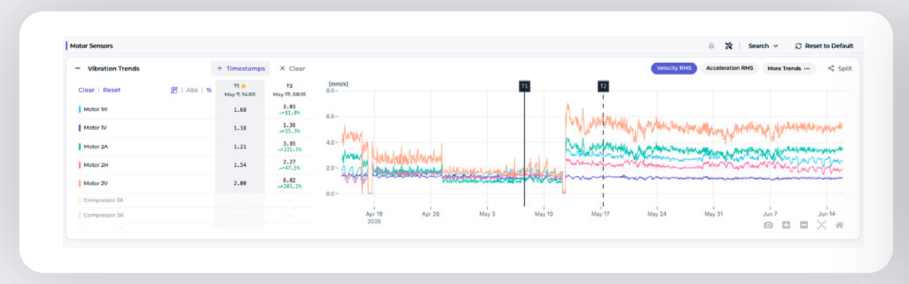
Velocity RMS trend showing changes in vibration severity across different operating conditions, including an increase from approximately 1.5 mm/s to 6.0 mm/s.
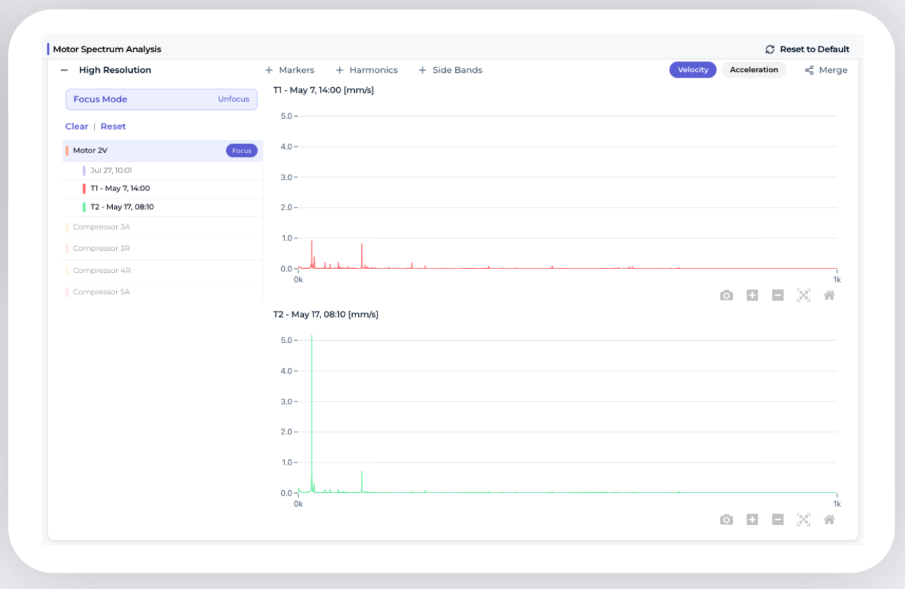
Frequency-spectrum analysis showing growth in the dominant 1× running-speed component, providing further evidence consistent with structural looseness.
Based on these findings, DataMind AI recommended:
- Correlating vibration with suction pressure, discharge pressure and temperature
- Inspecting the compressor foundation and mounting hardware
- Performing Motion Amplification (MA) and/or ODS/Modal Testing to assess structural integrity
Confirmation and Resolution
Following the deterioration identified by DataMind AI, the maintenance team performed a targeted physical inspection of the compressor structure and foundation.
The inspection confirmed loose foundation mounting studs and a visible crack in the compressor frame, validating the structural looseness diagnosis. The site was therefore able to address the underlying structural issue during a planned maintenance shutdown before it developed into a major compressor failure.
Conclusion
This case demonstrates the value of moving beyond conventional vibration thresholds to AI-driven fault diagnosis. While the site’s routine inspections assessed the compressor as healthy based on overall vibration levels, DataMind AI™ went deeper – analyzing vibration behavior across operating conditions to identify the underlying structural looseness.
By translating complex vibration behavior into a specific diagnosis and targeted maintenance recommendations, DataMind AI enabled the site to identify loose foundation mounting studs and a compressor frame crack before a major failure occurred.
Don’t let the next failure go undetected.
Explore 50+ real-world case studies showing how DataMind AI saves mining operations millions — or book a live demo to see it in action.
Fill in the form to download the case study
Don’t let the next failure go undetected.
Explore 50+ real-world case studies showing how DataMind AI saves mining operations millions — or book a live demo to see it in action.